


Rankin/Bass Productions
A great collection of original production animation cels, original production animation drawings, and master production backgrounds for sale from Rankin/Bass Productions.

Original hand painted and production animation cels of Marlon, Tito, Jackie, Jermaine, and Michael from "The Jackson 5ive," 1971-72; Rankin/Bass Productions; Production numbers in ink lower cel edges; Set on a lithographic background; Size - Marlon, Tito, Jackie, Jermaine, & Michael: 7 1/2 x 13 1/4", Image 8 1/2 x 14 1/4"; Unframed; SOLD!

Original hand painted production animation cels of Michael and Red & Blue Flowers from "The Jackson 5ive," 1971-72; Rankin/Bass Productions; Production numbers in ink bottom edges; Set on a lithographic background; Size - Michael & Flowers: 9 1/4 x 12", Image 9 1/2 x 13"; Unframed; SOLD!

Original hand painted production animation cels of Michael and a Bicycle from "The Jackson 5ive," 1971-72; Rankin/Bass Productions; Production numbers in ink bottom edges; Set on a lithographic background; Size - Michael & Bicycle: 7 1/4 x 11", Image 9 x 12 1/4"; Unframed; SOLD!

Original hand painted production animation cels of Marlon, Tito, Jackie, Jermaine, and Michael from "The Jackson 5ive," 1971-72; Rankin/Bass Productions; Production numbers in ink bottom edges; Set on a lithographic background with lithographic car overlay; Size - Marlon, Tito, Jackie, Jermaine, & Michael: 6 1/2 x 8 1/4", Image 11 1/2 x 16 1/4"; Unframed; SOLD!

Original hand painted production animation cels of Michael and Tito from "The Jackson 5ive," episode "Michael in Wonderland," 1972; Rankin/Bass Productions; Production numbers in ink bottom edges; Set on a lithographic background; Size - Michael & Tito: 5 1/4 x 5", Image 9 x 13 1/4"; Unframed; SOLD!

Original hand painted production animation cels of Michael, Marlon, and Goose from "The Jackson 5ive," episode "Jackson and the Beanstalk," 1972; Rankin/Bass Productions; Production numbers in ink bottom cel edges; Set on an original watercolor background; Production numbers in ink bottom edge; Size - Michael, Marlon, & Goose: 6 1/2 x 10 1/4", Image 8 x 12", Background 9 3/4 x 12"; Unframed; SOLD!

Original hand painted production animation cels of Bilbo, Thorin, Balin, Bard, and Eleven Men of Lake-town from "The Hobbit," 1977; Rankin/Bass Productions; Set on a key original hand painted master production background; Size - Fifteen Characters: 6 1/2 x 10 1/4", Image 8 x 10 1/2", Background 8 x 10 1/2"; Unframed; SOLD!

Original hand painted production animation cels of Michael and a Witch from "The Jackson 5ive," episode "Michael White," 1972; Rankin/Bass Productions; Production numbers in ink bottom edges; Set on a lithographic background; Size - Michael & Witch: 7 1/4 x 9 1/2", Image 7 1/2 x 13 1/4"; Unframed; SOLD!

Original hand painted production animation cels of Marlon, Tito, Jackie, Jermaine, & Michael from "The Jackson 5ive," 1971-72; Rankin/Bass Productions; Production numbers in ink bottom cel edges; Set on the matching original watercolor background; Production numbers in ink upper edge; Size - Marlon, Tito, Jackie, Jermaine, & Michael: 8 3/4 x 24", Image 8 3/4 x 41", Background 11 1/2 x 42"; Unframed; SOLD!

Original hand painted and production animation cels of Marlon, Tito, Jackie, Jermaine, and Michael from "The Jackson 5ive," 1971-72; Rankin/Bass Productions; Production numbers in ink lower right corners; Set on a lithographic background; Size - Marlon, Tito, Jackie, Jermaine, & Michael: 7 1/2 x 11 1/2", Image 8 1/2 x 11 1/4"; Unframed; SOLD!
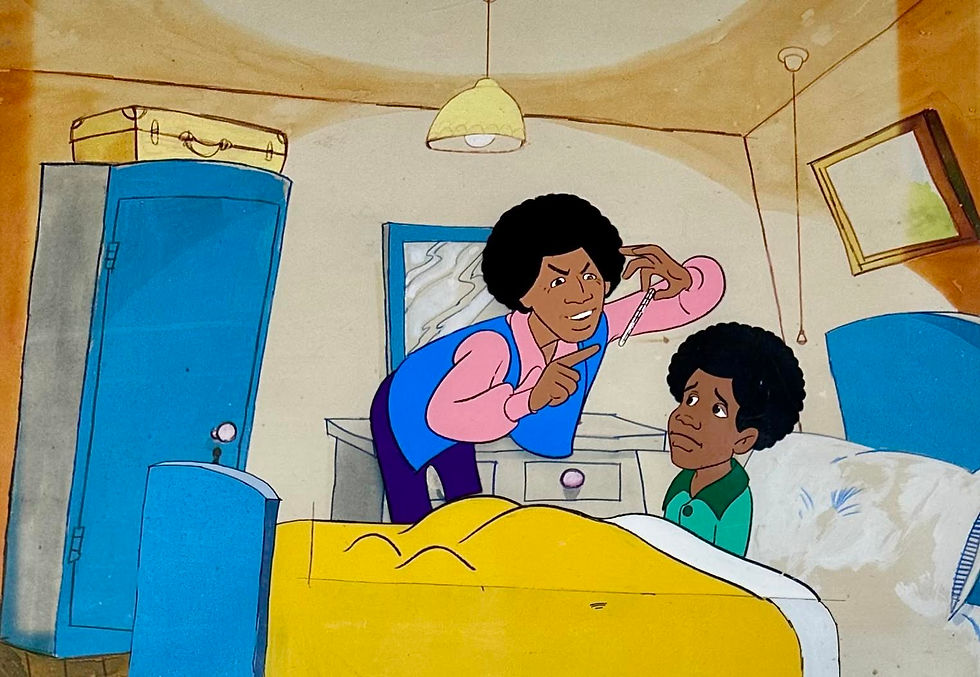
Original hand painted production animation cels of Jackie, Michael, Bed, and Blanket from "The Jackson 5ive," episode "CinderJackson," 1971; Rankin/Bass Productions; Production numbers in ink bottom cel edges; Set on the matching original watercolor background; Production numbers in ink bottom edge; Size - Jackie, Michael, Bed, & Blanket: 7 3/4 x 10", Image 11 x 15 1/4", Background 13 x 17 1/4"; Unframed; SOLD!

Original hand painted production animation cels of Frodo and Sam from "The Return of the King," 1980; Rankin/Bass Productions; Production numbers in ink upper cel edges; Set on a key original hand painted master production background; Production numbers upper right; Size - Frodo & Sam: 6 x 10", Image 8 x 10", Background 10 x 15"; Unframed; SOLD!

Original hand painted production animation cels of Marlon, Tito, Jackie, Jermaine, and Michael from "The Jackson 5ive," 1971-72; Rankin/Bass Productions; Signed by Robert Balser in ink lower right; Production numbers in ink bottom edges; Set on a lithographic background; Size - Marlon, Tito, Jackie, Jermaine, & Michael: 6 3/4 x 6 1/4", Image 9 x 10 1/2"; Unframed; SOLD!

Original hand painted and production animation cels of Members of The Jackson 5ive from "The Jackson 5ive," episode "Rasho-Jackson," 1972; Rankin/Bass Productions; Production numbers in ink lower cel edges; Set on a lithographic background; With matching original layout drawing; Size - Jackson 5ive: 9 1/2 x 12", Image 10 x 16", Layout Drawing 12 3/4 x 17 1/4"; Unframed; SOLD!

Original hand painted production animation cels of Marlon, Tito, Jackie, Jermaine, and Michael from "The Jackson 5ive," 1971-72; Rankin/Bass Productions; Production numbers in ink bottom edges; Set on a lithographic background with lithographic car overlay; Size - Marlon, Tito, Jackie, Jermaine, & Michael: 6 1/4 x 8 1/4", Image 10 1/2 x 15"; Unframed; SOLD!
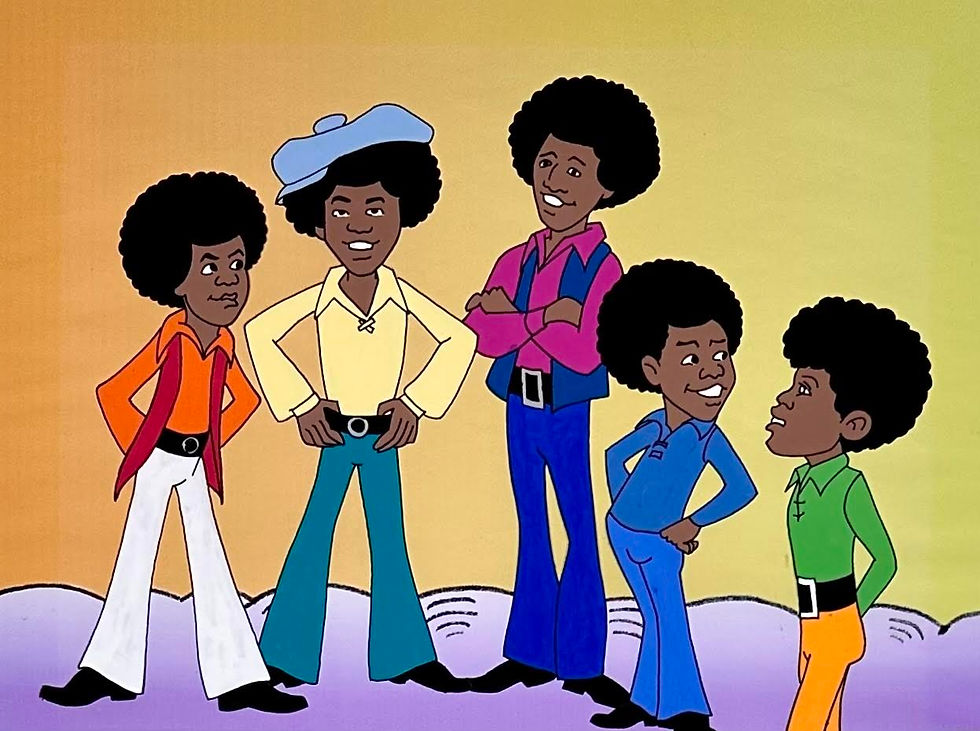
Original hand painted and production animation cel of Marlon, Tito, Jackie, Jermaine, and Michael from "The Jackson 5ive," 1971-72; Rankin/Bass Productions; Set on a lithographic background; Size - Marlon, Tito, Jackie, Jermaine, & Michael: 7 1/4 x 9 3/4", Image 8 1/4 x 11"; Unframed; SOLD!
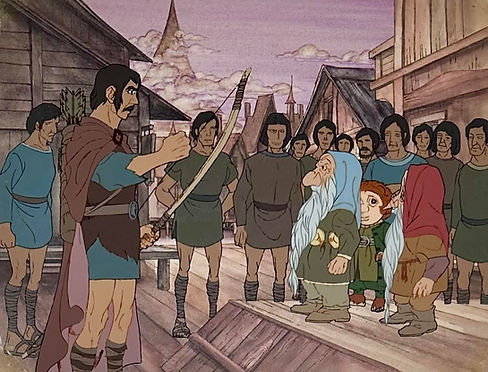
Original hand painted production animation cels of Bilbo, Thorin, Balin, Bard, and Eleven Men of Lake-town from "The Hobbit," 1977; Rankin/Bass Productions; Set on a key original hand painted master production background; Size - Fifteen Characters: 6 1/2 x 10 1/4", Image 8 x 10 1/2", Background 8 x 10 1/2"; Unframed.
Rankin/Bass Productions occupies a special place in the history of American animation. Founded by Arthur Rankin Jr. and Jules Bass in the early 1960s, the studio became famous for its highly distinctive television specials, especially its beloved holiday classics such as Rudolph the Red-Nosed Reindeer and Frosty the Snowman. Their productions were known for memorable music, richly stylized character designs, and a warm storybook quality that made them instantly recognizable. While many people primarily associate the studio with Christmas programming, Rankin/Bass also made
important contributions to fantasy animation, most notably through their adaptations of J.R.R. Tolkien’s works.
The Hobbit (1977) is perhaps one of Rankin/Bass’s most admired fantasy films. Produced as an animated television special, it adapted Tolkien’s 1937 novel into a concise yet remarkably faithful 78-minute film. The story follows Bilbo Baggins, Gandalf, Thorin Oakenshield, and the company of dwarves on their quest to reclaim the Lonely Mountain from Smaug. What makes this version so memorable is its visual atmosphere: watercolor-like backgrounds, expressive character designs, and creatures that feel both whimsical and unsettling. The animation itself was produced by Topcraft in Japan, giving the film an “anime-influenced” visual richness far beyond many American TV productions of its era.
Musically, The Hobbit is also deeply associated with the Rankin/Bass style. Songs such as “The Greatest Adventure” and the haunting goblin songs help drive the narrative in a way that feels very much in line with the studio’s holiday specials. Rather than simply retelling the plot, the music reinforces the mythic and fairy-tale tone of Tolkien’s world. The voice cast is equally notable, with Orson Bean as Bilbo and John Huston as Gandalf lending the film a sense of gravitas and warmth. For many viewers, this version was their first introduction to Middle-earth long before Peter Jackson’s live-action films.
Three years later, Rankin/Bass returned to Tolkien with The Return of the King (1980), an animated television film that served as a sequel to The Hobbit. Unlike Peter Jackson’s later trilogy, this film adapts only the final volume of The Lord of the Rings, omitting the events of The Fellowship of the Ring and The Two Towers except for a brief recap at the beginning. This gives the film a compressed and somewhat episodic structure, moving quickly through Frodo and Sam’s journey to Mount Doom and the climactic destruction of the Ring.
Although The Return of the King is often viewed as less successful than The Hobbit, it remains fascinating as part of Rankin/Bass’s Tolkien legacy. The film retains the studio’s signature musical storytelling and visual style, with memorable sequences such as the orc marching song “Where There’s a Whip, There’s a Way.” Its framing device, with Bilbo hearing the tale retold in Rivendell, gives it an almost ballad-like structure. While critics and even Arthur Rankin himself later regarded it as less effective, the film has nonetheless earned a nostalgic following among fans of classic animation and Tolkien adaptations.
Together, these two films demonstrate how Rankin/Bass could move beyond holiday nostalgia and successfully bring epic fantasy to television audiences. Their adaptations remain important not only as Tolkien films but as landmarks in animation history, bridging American storytelling sensibilities with Japanese artistry through Topcraft’s work. For many fans, they represent a uniquely dreamlike and folkloric vision of Middle-earth that still holds charm nearly fifty years later.
The Hobbit (1977) is a landmark animated adaptation of J.R.R. Tolkien’s beloved fantasy novel, produced by Rankin-Bass and animated by the Japanese studio Topcraft. The film introduced generations of viewers to Middle-earth through its distinctive visual style, memorable songs, and faithful presentation of the novel’s central themes of adventure, friendship, and the corrupting influence of greed. Topcraft’s contribution to the production is especially significant in animation history, as the studio would later evolve into companies that included Pacific Animation and the future Studio Ghibli. The film’s richly painted backgrounds, credited to Hidetoshi Kaneko and Minoru Nishida, helped create a vivid and atmospheric version of Tolkien’s world despite the constraints of television animation.
The original hand painted production animation cel setup captures a pivotal moment in the story at approximately the 50:12 mark of the film. In this scene, Bard and Thorin Oakenshield forge an alliance in Esgaroth, better known as Lake-Town. Thorin declares, “What help we can offer will be yours, and we trust to your gratitude when the dragon Smaug is killed and your kingdom is regained!” The statement reflects the mutual interests of the dwarves and the people of Lake-Town, both of whom hope to benefit from the defeat of Smaug and the restoration of prosperity to the region. This alliance serves as an important narrative step toward the climactic events surrounding the Lonely Mountain.
The image itself provides an excellent example of the artistry involved in traditional cel animation. In the foreground, Bard stands prominently on the left side of the composition, addressing Thorin and the dwarves. His confident posture and raised arm emphasize his leadership role among the people of Lake-Town. Opposite him stand Thorin and members of his company, including the figure of Bilbo Baggins visible between the dwarves. The arrangement of the characters visually reinforces the diplomatic nature of the scene, with the two groups facing one another as they negotiate their shared future. The gathered townspeople in the background further suggest that this is a public and significant occasion.
Particularly striking is the original Key Master background, painted in gouache on board. The artwork depicts the wooden walkways and buildings of Lake-Town stretching into the distance beneath a softly colored sky. The architecture creates depth and perspective, drawing the viewer’s eye through the settlement toward the horizon. The background also includes the Lonely Mountain looming beyond the town, a constant reminder of the dwarves’ ultimate destination and the dragon Smaug’s presence. The careful rendering of the environment demonstrates the skill of the background artists and contributes greatly to the film’s immersive fantasy atmosphere.
As a piece of animation history, this setup is especially noteworthy because it consists of four original hand-painted cels displayed over their original production background. Such complete setups are considerably rarer than individual cels, as animation elements were often separated or discarded after filming. The artwork preserves a key dramatic moment from one of the most celebrated animated fantasy films of the twentieth century. Beyond its value as a collectible, the cel offers insight into the craftsmanship behind The Hobbit and serves as a tangible connection to a production that helped shape the visual legacy of Tolkien’s work on screen.
#RankinBass #RankinBassProductions #ArthurRankinJr #JulesBass #ClassicAnimation #AmericanAnimation #AnimationHistory #HolidaySpecials #RudolphTheRedNosedReindeer #FrostyTheSnowman #TheHobbit1977 #TheReturnOfTheKing1980 #Tolkien #JRRTolkien #MiddleEarth #BilboBaggins #FrodoBaggins #SamwiseGamgee #Gandalf #Topcraft #AnimeInfluence #FantasyAnimation #AnimationCel #VintageAnimationArt #StorybookStyle #MountDoom #Mordor #Nostalgia #CollectibleCel #EpicFantasy